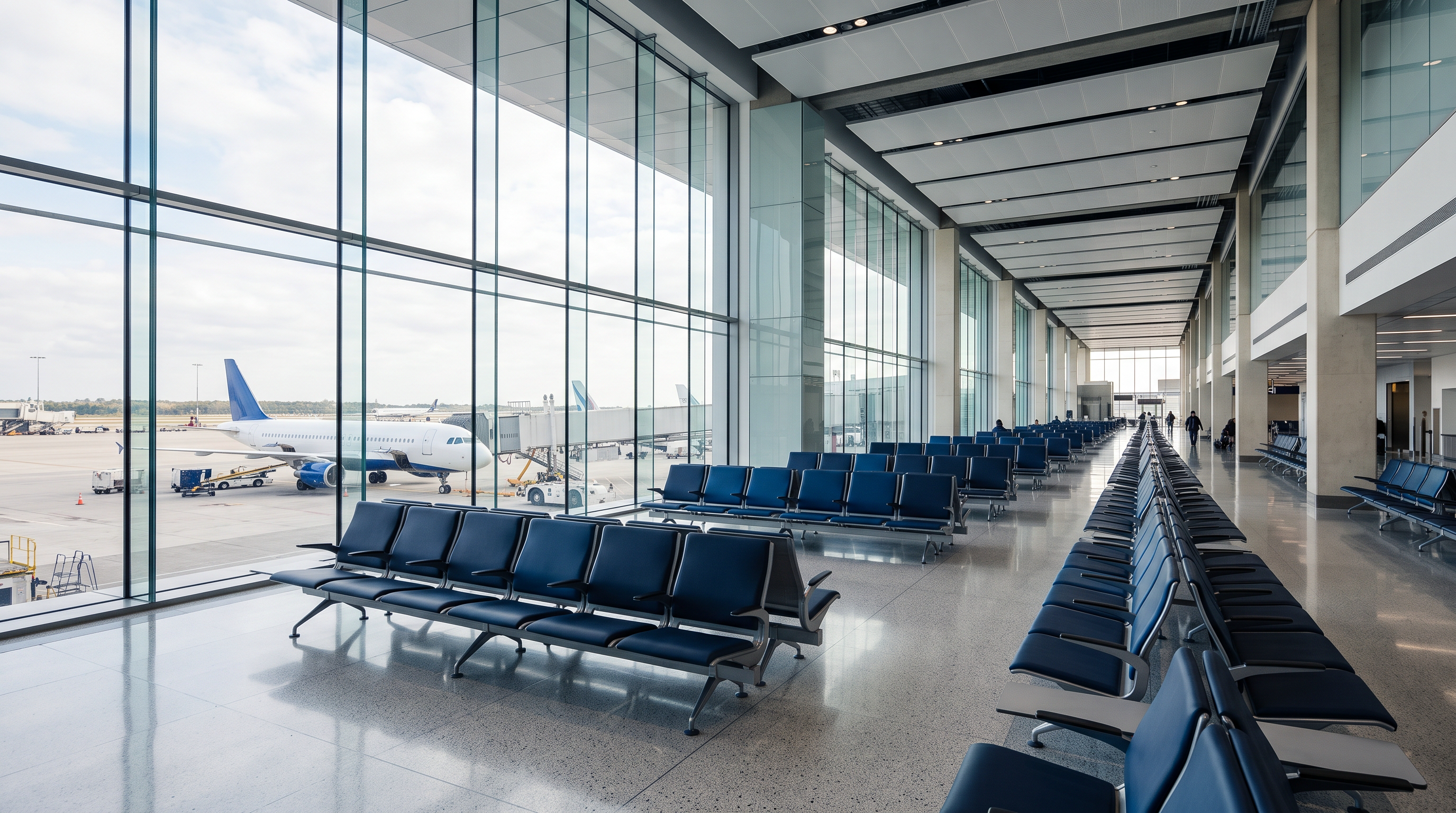
When you are procuring seating, casework, counters, and millwork for a new terminal pier or a duty-free hall, the cheapest line on the quote is rarely the cheapest project. The way you buy from China — not just what you buy — decides who carries the fire-compliance risk, who inspects before the container leaves, and who answers the phone when a finish arrives wrong six weeks before opening.
Short answer: Buying direct gives the lowest unit price but leaves you coordinating factories, QC, freight, and customs while carrying all spec and fire-compliance risk. A trading company simplifies invoicing but marks up goods and hides the factory. A managed sourcing agent like Trade Entrust discloses and vets the factory, inspects before shipment, holds the contract, and ships DDP on a transparent FOB fee.
What are the three FF&E sourcing models, exactly?
The three options sound similar on a quote, but they allocate risk very differently.
Buying direct from the factory. You contract the manufacturer yourself, typically against an FOB or EXW price. The unit cost is the lowest available because no intermediary is involved. In exchange, you become the project's general contractor for procurement: you qualify the factory, negotiate tooling and lead times, arrange your own pre-shipment inspection, book freight, clear customs, and chase any defect. For an immovable terminal-opening date, every one of those is now your liability — including verifying that the upholstery meets the architect's fire schedule.
Buying through a trading company. A trading company buys the goods, marks them up, and re-sells them to you under a single invoice. This is genuinely convenient: one PO, one payment, one point of contact. The trade-off is structural. Because the trading company's margin is the spread between what the factory charges and what you pay, its incentive is to keep the factory anonymous so you cannot go around it. You usually cannot audit the real unit cost, cannot inspect the line yourself, and cannot confirm which mill is actually building your fire-rated seating.
Using a sourcing agent / managed partner. A managed sourcing partner such as Trade Entrust works on a disclosed, transparent FOB fee rather than a hidden goods markup. The factory is named and vetted; you see the FOB cost; the agent inspects before the goods ship and holds the supplier contract on your behalf, then delivers DDP with customs handled. The accountability sits with one party whose paid job is your interest, not the factory's.
How do the three models compare side by side?
The table below maps each model against the risks that actually decide an airport FF&E project.
| Criterion | Buying direct | Trading company | Sourcing agent (Trade Entrust) |
|---|---|---|---|
| Factory disclosure | Full — you chose it | Hidden by design | Disclosed and vetted |
| Who the party works for | You do the work yourself | Itself (margin on goods) | You (transparent FOB fee) |
| QC before shipment | Your responsibility to arrange | Often "trust us," limited visibility | AQL 2.5 QC — DUPRO + PSI, photo reports |
| Accountable contract holder | You, with each factory | Trading company (factory unknown) | Trade Entrust holds the supplier contract |
| Fire / standard verification | You must specify and verify | Opaque; hard to audit | Verified against the fire schedule |
| Landed-cost transparency | Low unit price, you add all costs | Bundled markup, not itemised | Transparent FOB + DDP, itemised |
| DDP / customs | You arrange and clear | Varies; often FOB only | DDP with customs handled |
| Fit for a fixed opening date | High coordination risk on you | Single PO, but limited control | Managed to the deadline, 5-gate tracking |
Read the table as a spectrum of control versus convenience. Buying direct gives maximum control over cost and zero help with execution. A trading company gives maximum invoicing convenience and minimum visibility. A managed sourcing agent is built to give you visibility and execution support, which is why it tends to fit complex, deadline-bound terminal work.
Why does airport FF&E raise the stakes more than ordinary furniture?
Most retail or office furniture buys forgive a slow supplier or a marginal finish. Airport interiors do not, for three reasons.
Fire and flammability standards are non-negotiable. Seating, banquettes, and soft furnishings in a terminal commonly have to satisfy ignition-source standards such as EN 1021 (parts 1 and 2), BS 5852 Crib 5 for higher-risk public assembly areas, and — for North American scopes — California TB 117. These are not marketing claims; they are tested constructions. If a factory swaps a foam or a fabric to hit a price, the certificate on file no longer describes the part in the box. Verification before shipment is the only reliable defence, and it has to be done by someone who can read the schedule and inspect the line.
The architect's "or-equal" substitution gate. Terminal specifications frequently name a product "or equal." Getting a Chinese-made alternative approved as equal means documenting construction, finish, performance, and fire data to the design team before you commit tooling. Miss that gate and an entire production run can be rejected on site, even if it is well made.
Liquidated-damages deadlines. A terminal opening is a contractual, often politically visible date. Many head contracts attach liquidated damages to delay. That changes the maths entirely: a few weeks saved on unit price is meaningless against per-day LDs if a container is held at the border or a defect forces a remake. The sourcing model that protects the date usually wins on total cost.
This is the core of the accountability case. The cheapest unit price is only cheap if the goods are compliant, on the water on time, and cleared into the country — and someone is contractually answerable if they are not.
When is a trading company actually the right choice?
To be fair: not every purchase needs a managed partner. A trading company can be the sensible, lowest-friction option when the buy is small and genuinely simple — a one-off order of standard, non-fire-critical items, off the shelf, with no "or-equal" approval, no liquidated-damages exposure, and a comfortable lead time. In that case the markup buys you a single invoice and you are not paying for vetting and inspection you do not need.
The calculus flips the moment the order is large, custom, fire-rated, spec-sensitive, or tied to a hard opening date — which describes almost every airport FF&E package. There, anonymity of the factory and limited QC visibility become the expensive part.
How do I choose the right sourcing model? (Checklist)
Work through these in order. Your answers point clearly to one model.
- Map your fire and standards exposure. List every line that must meet EN 1021, BS 5852 Crib 5, CAL TB 117, or a local code. Any fire-rated line argues for disclosed, verified sourcing — not an anonymous factory.
- Confirm the "or-equal" gate. Does the specification require design-team approval of substitutes? If yes, you need documented construction and performance data before tooling — a managed partner's deliverable.
- Quantify your deadline risk. Identify liquidated-damages clauses and the true drop-dead date. The higher the LD exposure, the more a managed-to-deadline model with milestone tracking is worth.
- Decide how much landed-cost transparency you need. If you must defend the number to a client or a board, an itemised FOB-plus-DDP structure beats a bundled trading-company markup.
- Allocate the QC responsibility honestly. If you cannot reliably put a qualified inspector on the line yourself before each shipment, do not buy direct — you are insourcing risk you cannot service.
- Decide who should hold the supplier contract. If you want one accountable party answerable for the goods, choose a model where that party holds the contract on your behalf.
- Sanity-check complexity vs. size. Small, simple, non-critical, generous timeline → a trading company may be fine. Large, custom, fire-rated, deadline-bound → managed sourcing.
How does Trade Entrust handle QC, DDP, and the factory relationship?
Trade Entrust is structured for exactly the high-stakes case above. We source and vet factories across China, Vietnam, and India and disclose the factory to you — there is no hidden mill. Quality is checked to AQL 2.5 with during-production (DUPRO) and pre-shipment (PSI) inspections, documented in photo reports, so the goods are verified against your fire schedule before the container is sealed. We hold the supplier contract on your behalf, quote a transparent FOB fee rather than a hidden goods markup, and deliver DDP with customs handled. Every order moves through ImportOS.ai five-gate tracking, so your estimators and FF&E procurement managers can see where each line stands against the opening date — and we can issue factory-visit and visa letters when your team wants to audit a line in person.
The result is the lowest total delivered risk for a terminal package, not just the lowest line on a quote.
Ready to compare your options against a fixed opening date? Get a quote and we will map your FF&E package to the sourcing model that protects your schedule, your budget, and your fire-compliance sign-off.