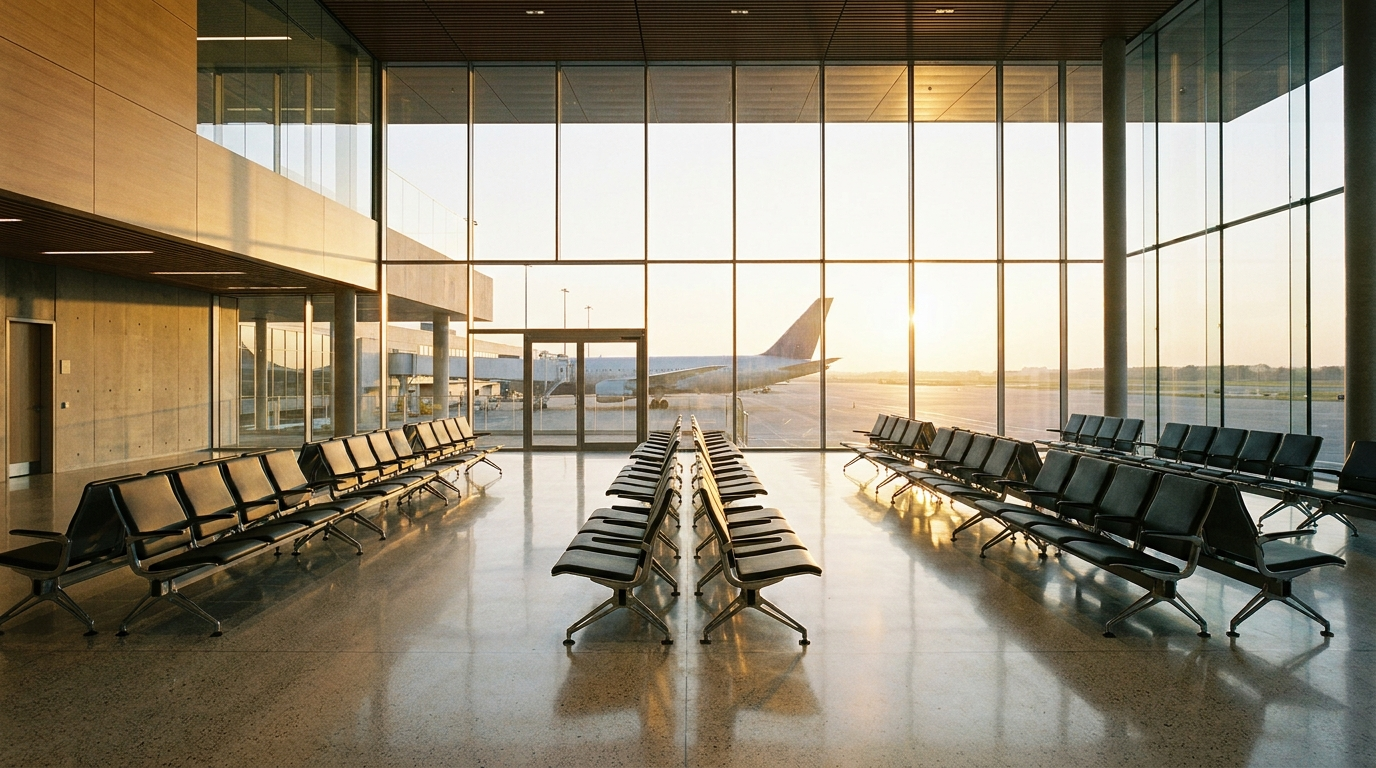
A fire marshal's sign-off is the last gate between a renovated concourse and its reopening date — and it is decided not by the certificate in your binder, but by the foam, fabric, and frame that actually rolled off the production line in China. For enterprise FF&E buyers, the gap between those two things is where reopening dates are lost.
Short answer: Airport terminal seating must meet the flammability standard of its jurisdiction — typically EN 1021-1/-2 across the EU/UK, BS 7176 Medium or High Hazard for UK public concourses, and CAL TB 117-2013 (often with TB 133) for US airports. The decisive risk is not the standard itself but whether the certified upholstered composite — that exact foam density plus that exact fabric — matches what ships. Verify it at the factory, not at the gate.
What fire rating does airport terminal seating actually need?
There is no single "airport" fire rating. The required standard is set by where the seat physically sits in the terminal and which authority signs off — building control, the airport authority, or the local fire marshal. A landside café chair and a high-occupancy departure-gate beam seat can carry very different obligations even inside the same building.
Three things matter to an enterprise buyer. First, flammability is tested on the composite — the specific combination of cover fabric, interliner (if any), and foam — not on the foam alone and not on the fabric alone. Second, contract-grade standards distinguish hazard levels by occupancy, so a "pass" is meaningless without knowing which hazard class it certifies. Third, fire performance and durability are separate questions: a seat can be fully fire-compliant and still fail after 18 months of footfall if the fabric was never rated for high-traffic contract use.
Get the standard mapping wrong and you don't find out in QA — you find out when the authority having jurisdiction refuses occupancy.
EN 1021 vs BS 7176 vs CAL TB 117: which applies where in the terminal?
The table below maps the major flammability standards to where each typically applies in a terminal, plus the durability benchmark that should sit alongside any fire spec for high-traffic seating.
| Standard | Test method (plain English) | Jurisdiction | Where it typically applies in a terminal |
|---|---|---|---|
| EN 1021-1 / -2 | Resistance to a smouldering cigarette (Part 1) + a match-equivalent flame (Part 2), tested on the cover-and-filling composite | EU / UK (and widely spec'd internationally) | Baseline landside and gate seating; the common floor most EU/UK contract seating must clear |
| BS 7176 — Medium Hazard | Composite assembly classification built on BS 5852 ignition sources, with FR treatment expectations | UK + specified internationally | Public concourses, lounges, moderate-occupancy gate areas |
| BS 7176 — High Hazard | Same framework, higher ignition-source severity | UK + specified internationally | High-occupancy departure gates, security/queue zones, dense waiting halls |
| BS 5852 Crib 5 | Burning-crib ignition source (the severe "source 5" test) | UK / very-high-hazard public buildings | Very-high-hazard public-building specs; sometimes invoked by airport authority or insurer above BS 7176 |
| CAL TB 117-2013 | Smoulder-resistance test, evaluated largely at the component level (cover, foam) | US | Component-level baseline frequently cited in US airport seating specs |
| CAL TB 133 | Full-assembly open-flame burn test on the finished seat | US (high-occupancy public occupancies) | Whole-seat requirement many US airport authorities/fire marshals impose for public terminals |
| Durability note: Wyzenbeek 100,000+ double rubs | Abrasion cycles to fabric failure (durability, not fire) | Global contract benchmark | Any high-traffic terminal seating — pair with the fire spec, never instead of it |
The single most expensive misread on this table is the CAL TB 117 vs TB 133 distinction. TB 117-2013 can be satisfied at the component level; TB 133 tests the entire finished seat assembly under open flame. A factory holding a TB 117 component certificate has not demonstrated TB 133 compliance — and a US fire marshal expecting full-assembly performance will say so on inspection day. The same trap exists in the EU/UK frame: an EN 1021 foam result is not a BS 7176 composite classification.
How do I read a contract seating fire test report — and what are the red flags?
A fire test report is only as good as its match to what is actually in production. The most common failures are not forged documents; they are real reports describing a different construction than the one being built. Use this checklist before approving any certificate as production-representative.
- Component-only certificate passed off as whole-assembly. A foam or fabric component report (e.g., CAL TB 117 component data) presented as if it satisfied a full-assembly requirement (CAL TB 133 or a BS 7176 composite classification). The test scope must match the authority's requirement.
- Expired or undated report. No issue date, or a report older than the standard's current edition (e.g., a pre-2013 TB 117 result against a TB 117-2013 spec). Confirm the edition cited matches your specification.
- Different foam density than production. The report names a foam density or grade that does not match the foam in the approved sample or the bill of materials. Foam substitution silently invalidates the composite result.
- Different fabric than what's installed. Fire performance is composite-specific; swapping the cover fabric — even for a "similar" one — voids the test. The fabric SKU on the report must equal the fabric SKU in production.
- Certificate "borrowed" from a different SKU or model. A valid report for another chair in the factory's catalogue, attached to your order because the constructions "look the same." They are different products until tested as one.
- No traceable link to your PO. The report cannot be tied to your specific order, materials lot, or approved sample — so there is no evidence the tested construction is the one being manufactured for you.
- Lab not named or not credible. No accredited testing house identified, or a name that cannot be verified. An unverifiable lab is an unverifiable result.
Red flags 3, 4, and 5 are the ones that pass desk review and fail at the gate, because the paperwork is internally consistent — it simply describes a different seat. Catching them requires checking the physical construction in production against the certified composite, which is an inspection task, not a document-review task.
What happens when the certified construction doesn't match production?
Consider a regional airport renovating a roughly 1,200-seat concourse against a fixed, publicly announced reopening date. The seating is sourced from China to a US specification: the fire marshal requires CAL TB 133 full-assembly performance for the high-occupancy gate zones.
The factory's pre-shipment paperwork looks clean — but the report on file covers only the foam (a TB 117 component result), not the upholstered composite the fire marshal will actually evaluate. On paper, every box is ticked. In reality, the finished seat as built has never been validated as an assembly, and the fabric specified in the report differs from the cover going onto the production line.
If this ships, the failure surfaces at the worst possible moment: containers landed, seats installed, and the authority having jurisdiction withholds occupancy days before reopening. The remedy — re-sourcing fabric, re-testing the assembly, re-manufacturing, and re-shipping 1,200 seats — blows past the reopening date and detonates the project budget.
The defense is to catch the mismatch at the factory, not at the gate. A during-production inspection that compares the certified construction to what is physically being built flags the component-vs-assembly gap and the fabric discrepancy while the line can still be corrected — and while there is still schedule float to fix it.
How does Trade Entrust verify fire-compliant seating before it ships?
Trade Entrust treats fire compliance as a construction-matching problem, not a paperwork problem. The objective at every check is the same: confirm that the seat being manufactured is the seat that was certified.
- Supplier vetting first. Factory sourcing and supplier vetting screen for manufacturers with genuine contract-furniture experience and verifiable, accredited fire test reports tied to real composites — not catalogue certificates borrowed across SKUs.
- DUPRO during production (AQL 2.5). A during-production inspection verifies that the foam density, fabric SKU, interliner, and frame in active production match the certified construction and your approved sample — catching component-vs-assembly and substitution gaps while the line is still running. Photo reports document the actual materials, not just a pass/fail mark.
- PSI pre-shipment (AQL 2.5). A pre-shipment inspection confirms the finished, packed goods still match the certified composite and the approved specification before anything leaves the factory — the final construction-match gate before the container is sealed.
- Factory-visit accompaniment. For a stakes-laden fit-out, Trade Entrust accompanies your team or owner's rep on-site (with China business-visa invitation letters arranged), so the people accountable for the spec can stand on the production floor and verify the composite themselves.
- One accountable counterparty. Supplier contracts are held by Trade Entrust, so there is a single accountable party for the certified construction across the whole order — no diffusion of responsibility between trader, factory, and forwarder.
- DDP door-to-door. DDP shipping and customs clearance move the verified seats from the factory floor to the terminal loading dock, so logistics risk doesn't reintroduce schedule slippage after the construction has been validated.
- ImportOS.ai 5-gate visibility. A live order-tracking portal runs the order through a 5-gate stage-gate process, giving FF&E procurement managers and owners' reps real-time visibility against the fixed opening date — so a problem at the construction-match gate is seen early, while there is still float to act, instead of discovered on installation day.
For a 1,200-seat concourse on a hard reopening date, that sequence is the difference between a fire marshal's signature and an empty terminal.
Sourcing fire-compliant airport seating is won or lost on whether the certified construction matches production — and that is verified on the factory floor, not at the gate. If you're fitting out a terminal against a fixed reopening date, get a quote and we'll map your fire and durability specs to a vetted supplier, then verify the certified construction through DUPRO and PSI before a single container ships.