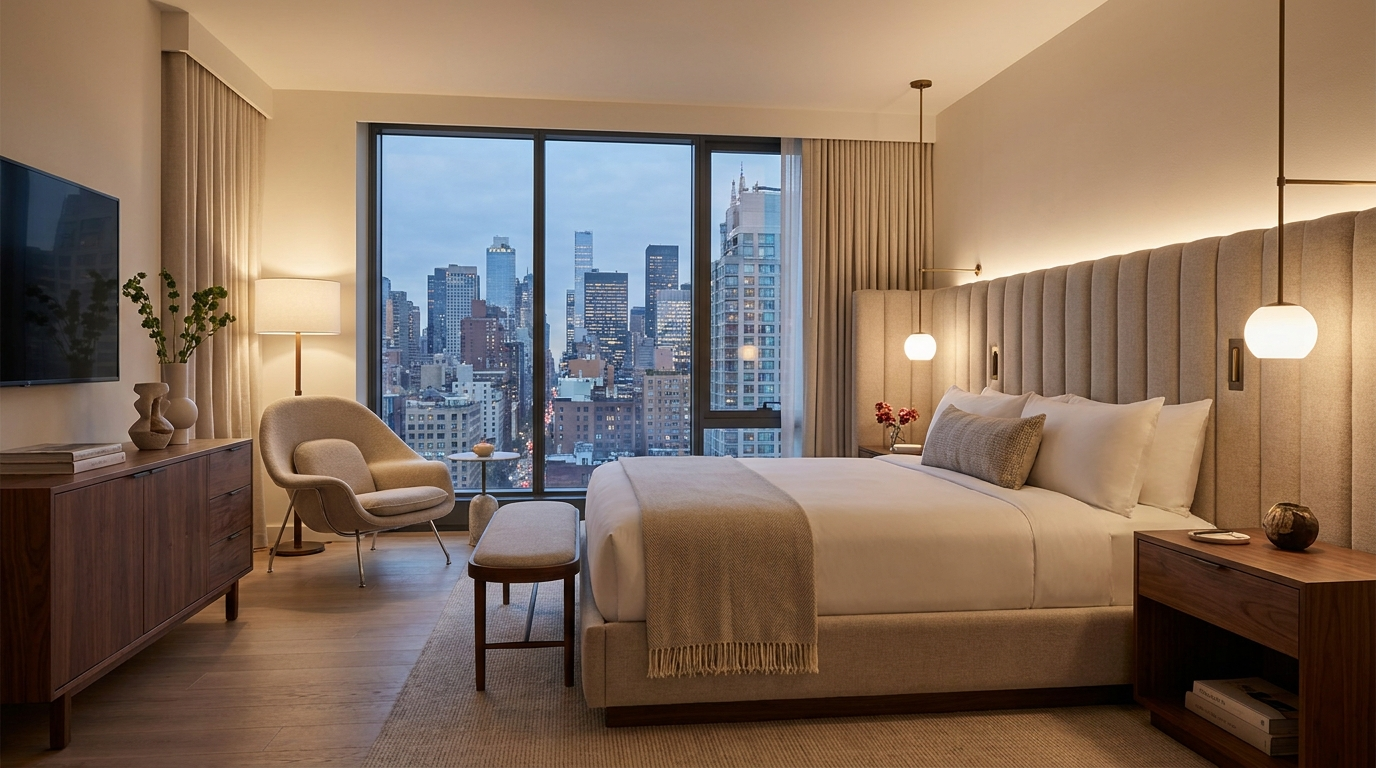
A 220-key upscale new-build has one date that cannot move: the pre-opening soft launch. Every headboard, nightstand, drape, rug, and reading lamp has to land on the property, brand-standard and undamaged, in time to install before the GM walks the floor. Sourcing that package from China is less about finding a furniture factory and more about orchestrating six of them to a single install calendar.
Short answer: To source hotel FF&E from China, lock the BOQ to brand standards, shortlist and vet factories per category, approve a golden sample for every SKU, then enforce AQL 2.5 inspections at DUPRO and pre-shipment with photo reports. Trade Entrust holds all supplier contracts as one accountable counterparty, consolidates ~6 factories into sealed containers, and ships DDP door-to-door — typically a 14–22 week runway against your install date, tracked through ImportOS.ai's 5 stage-gates.
What counts as hotel FF&E (and how is it different from OS&E)?
FF&E — Furniture, Fixtures & Equipment — is the loose, specified, brand-defining layer of a guestroom and the public areas. For a hotel package it typically covers:
- Case goods: wardrobes, desks, nightstands, dressers, headboards, minibar cabinetry, luggage benches.
- Seating: lounge chairs, desk chairs, sofas, banquette and lobby seating, restaurant chairs.
- Lighting: table and floor lamps, bedside reading lights, decorative pendants and wall sconces (the loose, plug-in or specified decorative fixtures — not the base-build wiring).
- Soft goods: drapery and sheers, bedding, duvets, bed runners, decorative pillows, cushions, upholstery.
- Carpets & rugs: broadloom guestroom carpet, axminster corridor runs, loose area rugs.
- Mirrors, artwork & accessories: framed art, decorative mirrors, headboard art panels, vanity mirrors.
FF&E vs. OS&E is the line every pre-opening team draws. FF&E is the durable, specified, often custom layer that defines the look and is usually capitalized. OS&E — Operating Supplies & Equipment — is the consumable, replaceable operational layer: linens in the par-stock sense, towels, glassware, in-room amenities, hangers, ice buckets, banqueting smallwares. A nightstand is FF&E; the carafe on it is OS&E. The two often ship together, but they carry different specs, different reorder cycles, and different accountability — and they should never be QC'd to the same standard. This playbook is about the FF&E layer, where consistency across hundreds of identical rooms is the entire game.
How does the FF&E procurement process work for a new-build hotel?
FF&E is a calendar problem disguised as a buying problem. Because every guestroom is a near-identical kit repeated 220 times, a single drifting finish or a single late factory can stall an entire floor's install. The process below is sequenced backward from the install date, with typical week-ranges. Categories run in parallel, so the total runway compresses — but the critical path is whichever factory is slowest plus its QC and transit.
- Specification / BOQ lockdown (Weeks 1–3). Translate the designer's FF&E schedule into a buildable Bill of Quantities: every SKU, dimension, material, finish code, fabric, foam density, and brand-standard requirement, with quantities per room type and per public area. This is the contract reference everything downstream is inspected against.
- Supplier shortlist & vetting (Weeks 2–5). Match each category to capable factories — case-goods, upholstery, lighting, carpet, soft goods — and vet them: capacity, contract-hospitality references, fire-retardancy capability, finish consistency at volume. A 220-key package usually lands across ~6 factories rather than one "do-everything" supplier, because category specialists hold standard better.
- Golden-sample approval (Weeks 4–8). Each factory produces a pre-production "golden sample" for sign-off on color, finish, foam, stitching, and dimensions. The approved sample is sealed and retained as the physical benchmark every production unit is later measured against. Nothing goes into bulk production until its golden sample is signed.
- PO & deposit (Weeks 7–9). Purchase orders issue against approved samples with locked specs, quantities, and a firm ex-works/ready date per factory. Deposits release production slots. With Trade Entrust as counterparty, these POs sit under one contract umbrella rather than six separate supplier agreements.
- During-production QC — DUPRO (Weeks 9–16). Inspectors visit factories mid-run, while there is still time to correct, and check production units against the golden sample at AQL 2.5. This is where finish drift, wrong foam density, and color variance get caught before a full container is built — not after it lands.
- Consolidation (Weeks 15–19). Finished, QC-passed goods from all ~6 factories converge at one consolidation point, are cross-checked against the packing manifest, and are loaded by room-type kit so the install crew unpacks in install sequence, not in random factory batches.
- PSI + DDP to site (Weeks 17–22). A final pre-shipment inspection (PSI) at AQL 2.5 with photo reports confirms quantities, packaging, and condition before the containers seal. Then DDP door-to-door — Trade Entrust handles export, freight, customs clearance, duties, and delivery to the property's receiving dock — landing ahead of the install window.
The week-ranges overlap deliberately. A realistic full-package runway is 14–22 weeks from BOQ lockdown to goods-on-site, but the only number that matters is the buffer between your latest factory's PSI-passed ship date and your install date.
Buy direct, through a dealer, or via a sourcing agent — which is right for an enterprise FF&E package?
There are three procurement models for getting a China FF&E package onto a property. They diverge most under the conditions that define a hotel build: many factories, brand-standard tolerance, and a fixed opening date.
| Dimension | Direct from China factories | Via an FF&E dealer | Via a sourcing agent (Trade Entrust) |
|---|---|---|---|
| Landed cost | Lowest unit price on paper, but you absorb freight, customs, duties, and rework yourself | Highest — dealer margin is built into every SKU | Transparent FOB-based fees on factory pricing; DDP rolls freight/duty into one quoted number |
| Brand-standard accountability | You own every spec gap; six factories each interpret the BOQ differently | Dealer owns it, but often re-sources to undisclosed factories you can't audit | Golden sample per SKU, inspected to the BOQ; one party accountable for the whole package |
| QC at scale | DIY — book inspectors, chase reports, hope you caught drift in time | Varies; QC depth and photo evidence are rarely transparent | DUPRO + PSI at AQL 2.5 with photo reports across all factories |
| Lead-time control | You coordinate ~6 independent ready-dates and chase laggards | Dealer's stock/lead times, not yours; limited visibility into the floor | Stage-gated against your install date; live status in ImportOS.ai |
| Single-counterparty risk | Six contracts, six relationships, six points of failure | One contract, but a sourcing black box behind it | One contract; Trade Entrust holds all supplier agreements as the accountable counterparty |
Direct buying wins on paper price and loses on the hidden cost of coordinating six factories to one date. Dealers simplify the relationship but bury the factory floor and the margin. The sourcing-agent model keeps factory-level pricing and visibility while collapsing six supplier relationships into one accountable counterparty — which is what matters when a slipped finish on one factory's floor threatens an entire pre-opening.
How do golden samples and AQL 2.5 keep hundreds of guestrooms consistent?
The defining risk in hotel FF&E is not a single bad chair — it's drift. Across a 5,000-unit production run spanning six factories and several weeks, color tones wander, lacquer sheen shifts batch to batch, foam suppliers substitute density, and stitching loosens as line workers rotate. In a retail order nobody notices. In a hotel, two adjacent rooms with visibly different headboard fabric is a brand-standard failure the GM will flag on the first walk.
Two mechanisms hold the line:
- The golden sample is the physical, signed-off benchmark for every SKU — approved for color, finish, foam density, dimensions, and construction before bulk production starts. It is sealed and retained, so QC is never an argument about opinion; it is a direct comparison of a production unit against the approved standard.
- AQL 2.5 inspection sets the statistical acceptance bar. Inspectors pull a sampled lot and the order passes only if defects stay within the AQL 2.5 limit. Trade Entrust runs this twice: DUPRO (during production), where catching foam-density or color drift mid-run still leaves time to correct the line, and PSI (pre-shipment), where the finished, packed goods are verified before the container seals. Both produce photo reports, so an owner's rep approving release from another continent sees the actual units, not a "passed" checkbox.
The sequencing is the point. DUPRO catches drift while it's fixable and cheap; PSI confirms the corrected output before it ships. By the time containers land, the variance that would have produced mismatched rooms has already been intercepted against the golden sample.
What about fire-retardancy for contract upholstery?
Hotels are public-occupancy buildings, and their seating, headboards, and drapery are contract-grade, not residential. Upholstered FF&E commonly has to meet flammability standards such as Crib 5 (BS 5852) for the UK/EU contract market or California TB 117 for North America, depending on the destination and the brand's own fire-safety standard. This is non-negotiable and it is a specification requirement, not a finishing afterthought — the foam, fabric, and interliner have to be compliant by composition, with documentation.
Practically, fire-retardancy belongs in the BOQ at lockdown and in the golden sample at approval, not discovered at PSI. Trade Entrust vets upholstery factories for the ability to build to the required flammability standard up front, confirms the compliant materials are what actually went into the golden sample, and verifies during DUPRO that the production run uses the approved fire-retardant components — so a public-occupancy compliance gap is closed before bulk production, not after a container of non-compliant seating has shipped.
Pre-opening FF&E readiness checklist
A practical sequence for FF&E purchasing managers, owners' reps, and pre-opening procurement leads working a multi-factory China package:
- Lock the BOQ to brand standards with full SKU-level specs — dimensions, finish codes, fabrics, foam density, and fire-retardancy standard per destination.
- Map every category to a vetted factory; expect ~6 specialist factories for a full 220-key package, not one generalist.
- Require a signed, sealed golden sample for every SKU before any deposit releases production.
- Issue POs under a single contract umbrella so you manage one counterparty, not six supplier relationships.
- Schedule DUPRO at AQL 2.5 mid-run on every factory floor and review the photo reports before goods finish.
- Confirm contract upholstery meets Crib 5 / CAL TB 117 (per market) with the compliant materials verified in production.
- Consolidate all factories into containers loaded by room-type kit, in install sequence.
- Gate the final PSI at AQL 2.5 with photo sign-off before any container seals.
- Ship DDP door-to-door to the property's receiving dock, with customs, duties, and delivery handled end-to-end.
- Track every factory's stage against the install date in ImportOS.ai's 5 gates, and hold a buffer between the slowest PSI-passed ship date and install day.
How does one accountable counterparty change the 220-key scenario?
Return to the 220-key new-build with a fixed pre-opening date and a full guestroom plus public-area package spread across ~6 factories. Run conventionally, the procurement lead is managing six contracts, six payment schedules, six QC arrangements, and six independent ready-dates — and is personally the integration point where any single slip becomes everyone's problem.
With Trade Entrust holding the supplier contracts, that collapses to one accountable counterparty. The team negotiates and tracks against one party that owns the whole chain: vetting and contracting all ~6 factories, running DUPRO and PSI at AQL 2.5 with photo reports across every floor, consolidating QC-passed goods into containers kitted by room type, and delivering DDP door-to-door to the property — export, freight, customs, and duties included. Throughout, ImportOS.ai's 5-gate stage-gate process shows each factory's true position against the install calendar, so a slipping floor surfaces as a gate that hasn't cleared — early enough to expedite or re-sequence — rather than as a no-show container during install week. Transparent FOB-based fees keep the factory-level economics visible the whole way through.
The result is the thing a pre-opening actually needs: hundreds of brand-consistent rooms, fire-compliant public-area seating, and one date that holds.
If you're building or renovating and need a full FF&E package sourced, QC'd, and landed on a fixed pre-opening date, get a quote and we'll map your BOQ to vetted factories with a stage-gated timeline against your install day.