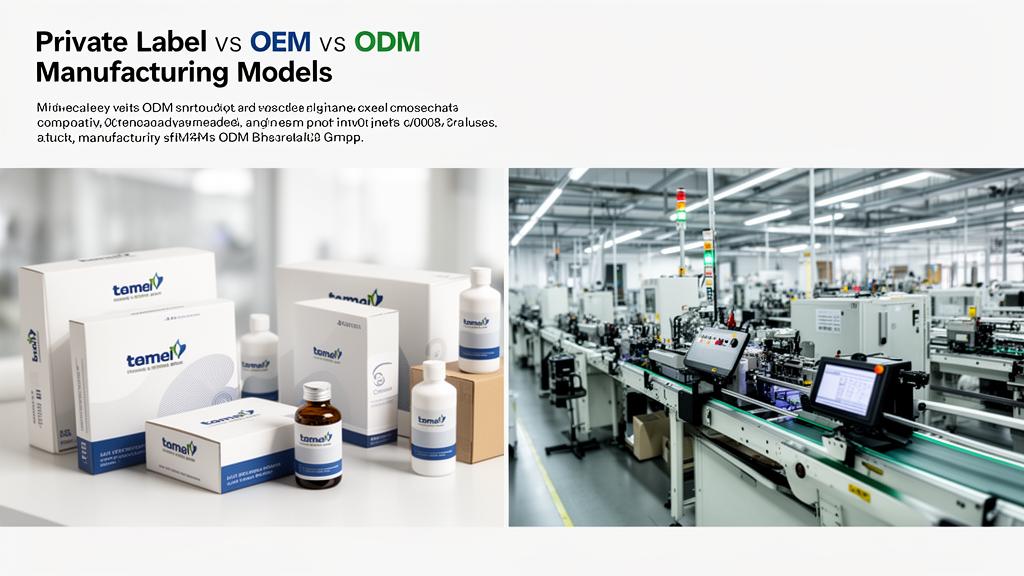
Private Label vs OEM vs ODM: Which Manufacturing Model is Right for Your Business?
When sourcing products from China, one of the first decisions you'll face is choosing your manufacturing model. Should you go with Private Label, OEM, or ODM? Each model offers different levels of customization, investment requirements, and control over your product.
Definitions at a Glance
| Model | What It Means | Customization Level | Investment |
|---|---|---|---|
| Private Label | Your brand on an existing product | Low (branding only) | Low |
| OEM (Original Equipment Manufacturer) | Custom product built to your specs | High (your design) | High |
| ODM (Original Design Manufacturer) | Manufacturer's design, your modifications | Medium (modify existing) | Medium |
Private Label: Fastest to Market
Private labeling means taking an existing product and adding your brand name, logo, and packaging.
How It Works
- Select an existing product from a manufacturer's catalog
- Add your branding (logo, labels, packaging design)
- The factory produces the product with your brand identity
- You sell it under your own brand name
Pros
- Lowest investment — no design or tooling costs
- Fastest time to market — products already in production
- Lower MOQs — often 100-500 units
- Proven products — the design is already market-tested
- Low risk — minimal upfront commitment
Cons
- No differentiation — competitors can sell the same product
- Limited customization — you're stuck with existing features
- Lower margins — easy for competitors to replicate
- Brand vulnerability — your brand is only as good as a commodity product
Best For
- Startups testing market demand
- Amazon FBA sellers entering new categories
- Businesses with strong marketing but no product development team
- Supplementary product lines alongside core offerings
Typical Costs
- Logo/packaging design: $200-$1,000
- Mold/printing plate changes: $100-$500
- MOQ: 100-500 units
- Total initial investment: $1,000-$5,000
OEM: Full Custom Manufacturing
OEM means you provide the complete product design, and the factory manufactures it according to your specifications.
How It Works
- You create detailed product specifications (CAD drawings, BOM, etc.)
- Factory reviews feasibility and provides quotation
- Tooling and molds are created (you own them)
- Prototype/sample production and approval
- Mass production begins
- Quality control at multiple stages
Pros
- Complete control — your design, your specifications
- Unique product — competitors cannot easily copy
- Higher margins — differentiation commands premium pricing
- IP ownership — you own the design and tooling
- Scalability — optimized for your specific needs
Cons
- High upfront investment — tooling, prototyping, development
- Longer lead time — 3-6 months from concept to production
- Higher MOQs — typically 1,000-5,000 units
- Risk — untested design may not succeed in market
- Complexity — requires technical knowledge or a sourcing partner
Best For
- Established brands with validated product concepts
- Products requiring specific technical specifications
- Companies with significant capital to invest
- Patentable innovations
Typical Costs
- Product design/engineering: $2,000-$20,000
- Tooling/molds: $3,000-$50,000+
- Prototyping: $500-$5,000
- MOQ: 1,000-5,000 units
- Total initial investment: $10,000-$100,000+
ODM: The Middle Ground
ODM means the manufacturer has already designed and developed the product. You can modify certain aspects (features, materials, specifications) and sell it under your brand.
How It Works
- Browse manufacturer's existing product catalog
- Select a base product
- Request modifications (colors, materials, features, sizing)
- Factory adjusts the design and produces samples
- Approve samples and begin production
Pros
- Moderate investment — leverage existing R&D
- Faster than OEM — base design already exists
- Some differentiation — modified specifications set you apart
- Lower risk — product concept is proven
- Technical expertise included — factory knows the product
Cons
- Limited IP protection — the core design belongs to the factory
- Semi-exclusive — other buyers may access similar products
- Modification limits — not all changes are feasible
- Dependency — reliant on factory's R&D capabilities
Best For
- Mid-stage businesses wanting differentiation without full OEM costs
- Companies entering markets with established product standards
- Importers with specific market requirements (voltage, sizing, regulations)
- Brands wanting quick iteration on product variations
Typical Costs
- Modification fees: $500-$5,000
- Minor tooling changes: $500-$3,000
- MOQ: 300-2,000 units
- Total initial investment: $3,000-$20,000
Comparison Matrix
| Factor | Private Label | ODM | OEM |
|---|---|---|---|
| Time to market | 2-4 weeks | 4-8 weeks | 12-24 weeks |
| Upfront cost | $1K-$5K | $3K-$20K | $10K-$100K+ |
| Product uniqueness | Low | Medium | High |
| MOQ | 100-500 | 300-2,000 | 1,000-5,000 |
| IP ownership | None | Partial | Full |
| Supplier dependency | High | Medium | Low |
| Profit margins | Low-Medium | Medium | High |
| Risk level | Low | Medium | High |
| Brand differentiation | Low | Medium | High |
Decision Framework
Ask yourself these questions:
Choose Private Label if:
- You're testing a new market or product category
- Your competitive advantage is in marketing, not product
- You have limited capital (<$5,000)
- Speed to market is your priority
Choose ODM if:
- You want differentiation without full development costs
- You need market-specific modifications (compliance, sizing)
- You have moderate capital ($5,000-$20,000)
- You want to iterate on existing proven products
Choose OEM if:
- You have a unique product design or patent
- Product differentiation is your competitive advantage
- You have significant capital (>$20,000)
- You're building a long-term brand
Hybrid Approach: Start Private Label, Evolve to OEM
Many successful brands follow this progression:
- Phase 1 (Months 1-6): Private label to test market demand
- Phase 2 (Months 6-12): ODM modifications based on customer feedback
- Phase 3 (Year 2+): Full OEM with custom-designed products
This approach minimizes risk while building toward a differentiated brand.
How Trade Entrust Helps You Choose
- We assess your business stage, budget, and goals
- We recommend the right manufacturing model
- We source factories specializing in your chosen model
- We manage the transition as your needs evolve
- We protect your IP throughout the process