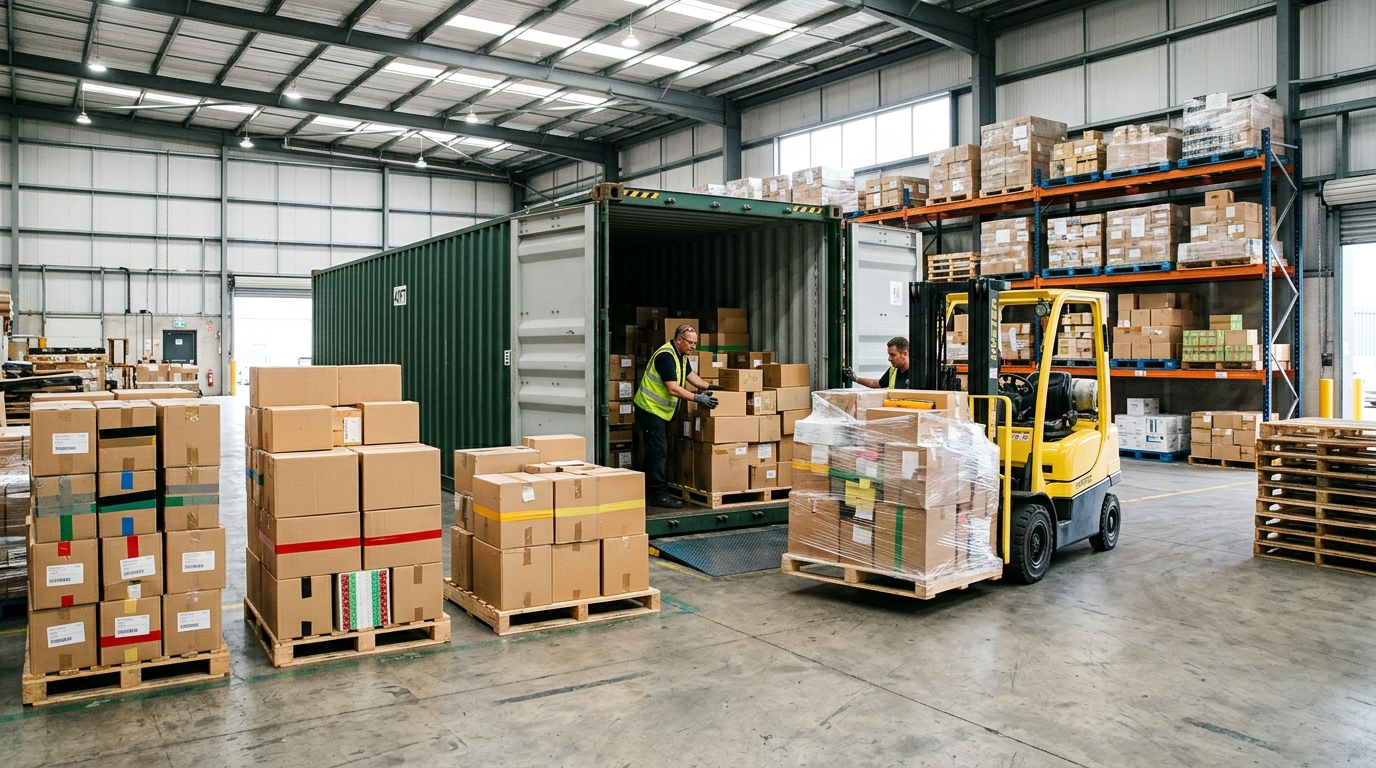
Short answer: Yes. Even when Product A and Product B come from two different factories in two different cities, you can consolidate suppliers into one shipment from China and cut your freight. Each factory delivers to a single consolidation warehouse (a hub), where the goods are received, combined, optionally inspected, repacked, and then shipped together under one bill of lading. You pay one set of fees instead of two and you fill more of the container — which is where most of the saving actually comes from.
Here is how consolidation works, when it pays off, and what a partner has to coordinate to make it run smoothly.
What consolidation is — and why it saves money
Freight consolidation from China means merging cargo from several suppliers into one shipment instead of letting each factory ship on its own. Rather than two separate bookings — one for Product A, one for Product B — everything meets at a single hub, is combined, and leaves as one consignment.
The saving comes from two places at once:
- One set of fees instead of several. Every separate shipment carries its own fixed costs: origin handling, export documents, a bill of lading, customs paperwork, destination charges, and often a forwarder or courier minimum. Ship from two suppliers separately and you pay most of those costs twice. Consolidate, and you pay them once.
- A fuller container. Ocean freight rewards density. A half-empty shipment still pays for minimums and space you are not using. When you combine multiple factories into one container, the same fixed cost is spread across more goods, so your cost per unit falls.
This is why two small, part-filled shipments almost always cost more than one combined shipment of the same total volume. You are not only paying for cubic metres — you are paying for the overhead attached to every separate booking. If your goods are light and bulky, the effect is stronger still, because volumetric weight when shipping from China means you are already paying for the space around the product; leaving that space half-empty across two shipments wastes money twice.
> The biggest waste in China freight is rarely the rate per cubic metre. It is paying full fixed costs on half-empty shipments — and then paying them again on the next one.
How a consolidation warehouse works
A consolidation warehouse — also called a hub, or a cargo consolidation warehouse in China — is a single receiving point, usually close to a major export port such as Shenzhen, Ningbo, or Shanghai. The process is straightforward:
- Each supplier delivers to one hub. Factory A sends Product A; Factory B sends Product B. Each ships domestically within China to the same address — a short, inexpensive trucking leg instead of a separate international one.
- Goods are received and checked in. The hub counts cartons, weighs and measures them, and confirms each delivery matches its packing list. Nothing moves forward until every supplier's goods have arrived.
- Optional inspection. Because the goods are already in one place, this is the natural moment to inspect them — quantity, workmanship, and packaging — before anything is sealed into a container.
- Combining and repacking. Loose cartons are palletised, mixed pallets are built, weak export packaging is reinforced, and wasted space is removed. Good repacking can shrink your total volume, which directly lowers the freight bill.
- One shipment, one bill of lading. The combined cargo leaves as a single consignment under one bill of lading, with one matched set of documents for customs at both ends.
The result is easy to picture: two suppliers, one shipment, one invoice, one tracking number.
When to consolidate: LCL vs FCL and the rough break-even
Consolidation works with both main sea-freight modes, but the math differs.
- LCL (less-than-container-load): your cargo shares a container with other companies' goods. You are quoted by volume — per cubic metre (CBM) — with a minimum charge. LCL consolidation from China is ideal for smaller combined volumes, because you get the benefit of one booking without needing enough goods to fill a whole container.
- FCL (full container load): you book an entire container for a flat rate, however full it is. FCL wins once you have enough combined cargo to fill most of a container, because that flat rate is then spread across more goods.
The turning point is roughly where filling one FCL beats paying for several small LCL shipments. As a rough rule of thumb, once your combined cargo passes somewhere around 13–15 CBM, a full 20-foot container often works out cheaper per unit than the equivalent LCL — and above roughly half a container, FCL is almost always worth pricing. Treat these as general guides, not fixed rates: the real break-even depends on the shipping lane, the season, and how dense your product is.
| Factor | Several separate LCL shipments | One consolidated shipment (LCL or FCL) |
|---|---|---|
| Fixed fees (documents, handling, bill of lading) | Paid on every shipment | Paid once |
| Container fill | Often half-empty | Fuller, less wasted space |
| Cost per unit | Higher | Lower |
| Handling and damage risk | More handling steps | One controlled hub |
| Inspection before export | Hard to coordinate | Done in one place |
| Best when | You genuinely need one item fast | Volumes from two or more suppliers can travel together |
A simple way to decide: add up the volume from all your suppliers. If it comfortably fills most of a container, ask for an FCL price. If it does not, consolidate everything into one LCL booking. Either way, combining suppliers beats shipping each factory alone.
What a sourcing partner coordinates
On paper, consolidation is simple. In practice, the hard part is coordination — and it is where things go wrong without someone running the hub. When you buy from different suppliers and want one shipment, a sourcing partner manages:
- Collection timing across factories. Factory A may finish two weeks before Factory B. Someone has to track each production schedule, arrange domestic pickup, and hold the earlier goods at the hub without running up storage costs — so the shipment leaves as soon as the last item is ready, not weeks late.
- Quality control at the hub. With everything in one place, a partner can check quantity and quality before consolidation, so a defective batch from one supplier is caught in China rather than shipped across the world before anyone notices.
- Repacking and load planning. Rebuilding pallets, reinforcing cartons, and planning how the container is loaded to protect fragile goods and use every cubic metre.
- One shipment and clean paperwork. A single booking, one bill of lading, and documents that match — so customs clearance is not delayed by mismatched packing lists from two different factories.
Without this, buyers usually default to letting each factory ship on its own, and quietly overpay on freight, order after order.
How Trade Entrust handles it
Trade Entrust runs the hub for you. When you want to consolidate suppliers into one shipment from China, we manage the whole chain, from the factory floor to the sailing:
- We collect from each factory. We arrange domestic pickup from every supplier and bring all your goods to one consolidation warehouse in China, timed around each factory's production schedule.
- We inspect before we combine. Your goods are checked for quantity and quality at the hub, before anything is sealed into a container — so problems are found here, not at your door.
- We consolidate and repack. We build and reinforce pallets, remove wasted space, and plan the load to protect fragile items and fill the container efficiently.
- We ship it as one. Everything leaves under a single bill of lading, with one matched set of documents — so you stop paying for half-empty shipments and start paying for one full one.
Bottom line
Yes — you can combine Product A and Product B from two different suppliers into one shipment, and in almost every case you should. You avoid paying duplicated fixed fees, you fill more of the container, and you get one clean shipment instead of several loose ones. The only real decision is whether your combined volume calls for a consolidated LCL booking or a full container. Get that right, and you stop overpaying on freight.
Ready to stop paying for half-empty shipments? Get a quote from Trade Entrust, and we will collect, inspect, and consolidate your suppliers into one shipment — or first see how it fits your total landed cost from China.