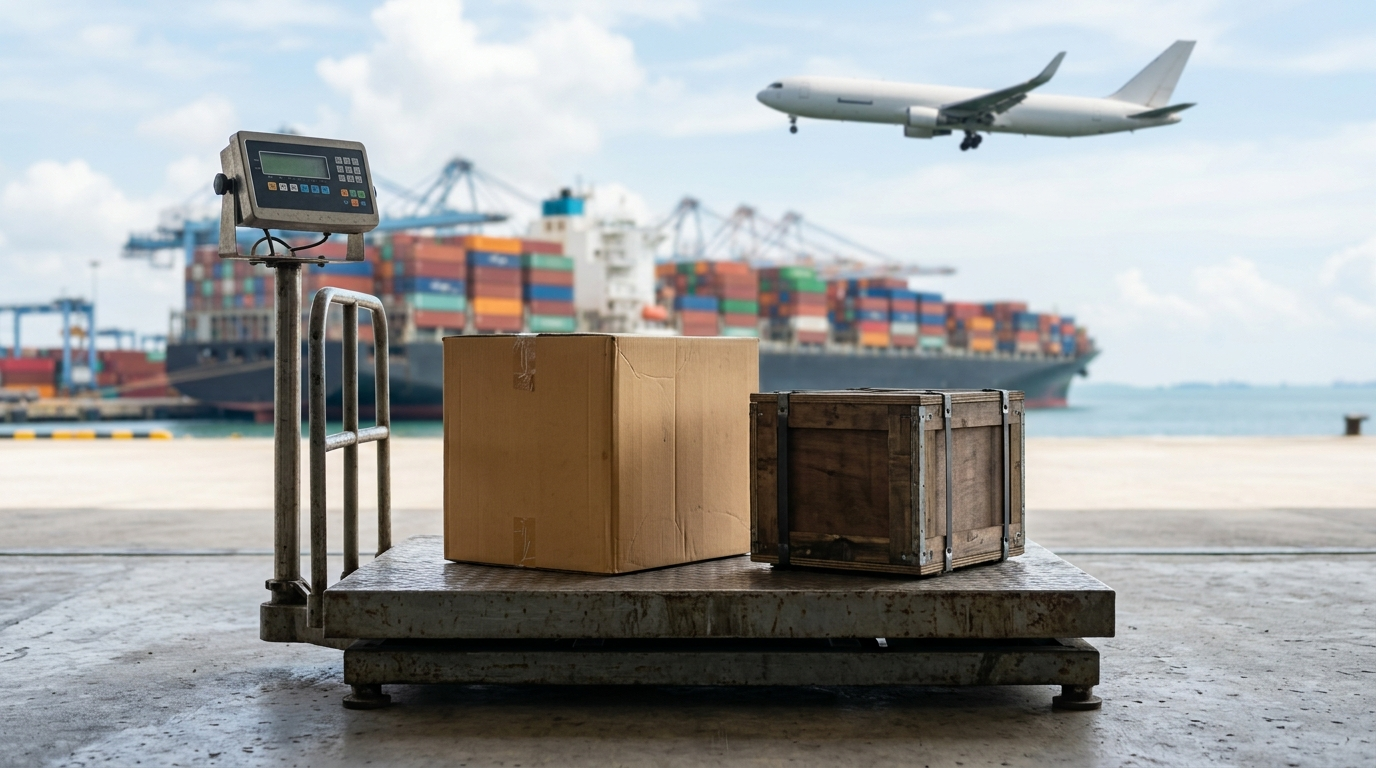
Short answer: Freight often costs more than your goods because carriers charge for space, not just weight. With volumetric weight shipping from China, you pay for whichever is greater — the actual (gross) weight of your cargo or its "volumetric" (dimensional) weight, which converts the space a box occupies into a billable weight. Bulky-but-light products — cushions, lampshades, plastic housings — take up a lot of room for very little weight, so the volume charge wins and the bill rises sharply. Choose the right mode, pack denser, and the freight drops fast.
That surprise on the invoice is not a mistake, and it is not a scam — it is how the whole freight industry prices cargo. Here is exactly how it works and how to bring the number down.
How freight is really priced: greater of actual or volumetric weight
The single rule to remember: you pay for whichever is greater, your actual weight or your volumetric weight. This is dimensional weight explained in one line. Carriers — airlines, couriers, ocean lines — have a fixed amount of space to sell. A plane or a container fills up on volume long before it reaches its weight limit, so pricing has to protect the space, not only the scale.
Volumetric weight (also called dimensional or "dim" weight) turns the size of your carton into a weight the carrier can bill. For air freight and courier, the industry uses a divisor: you multiply length x width x height in centimetres, then divide by a standard number. The commonly used air-freight volumetric divisor sits around 5000–6000 cm3 per kilogram, depending on the carrier and service. Whatever the box "weighs" on that formula is compared to what it weighs on the scale, and the higher figure is charged.
A quick, rounded example (illustrative, not a quote): a carton measuring 60 x 40 x 40 cm is 96,000 cubic centimetres. Divide by a 6000 divisor and its volumetric weight is 16 kg. If the goods inside actually weigh 7 kg, you are still billed as if they were 16 kg — because the space is what you used.
Sea freight uses the same idea in a different unit. Ocean cargo is priced largely by CBM shipping cost — cubic metres (CBM). One CBM is one metre by one metre by one metre. A less-than-container-load (LCL) shipment is quoted per CBM (again, with a weight-or-volume rule for very dense cargo), and a full container (FCL) is a flat price for the whole box, so the more CBM you pack into it, the lower your cost per unit. This volume-based logic is also why understanding volumetric weight shipping from China is central to your total cost — freight is one of the biggest lines in it. For the full picture of every cost between the factory and your door, see our guide to total landed cost from China.
> Key insight: carriers sell space, not just weight. If your product is light and airy, you are shipping and paying for a lot of packaged air.
Air vs sea freight from China: when each wins
The next lever is mode. Air vs sea freight from China is a trade-off between speed and cost, and the right answer depends on three things: how urgent the order is, the value-to-weight ratio of the goods, and the total volume you are moving.
Air freight is fast and priced on that volumetric formula, so it rewards small, dense, high-value cargo — electronics, spare parts, samples, anything where speed protects a sale or a cash-flow gap. Sea freight is slow but priced by volume in CBM and is much cheaper per unit for anything large or heavy. Once you are filling multiple cubic metres, sea almost always wins on cost.
| Factor | Air freight | Sea freight |
|---|---|---|
| Speed | Days | Weeks |
| Priced by | Volumetric (dim) weight vs actual weight | CBM (volume), or weight if very dense |
| Best for | Urgent, high-value, low-volume, dense goods | Large volume, heavy or bulky, cost-sensitive goods |
| Cost per unit | Higher | Much lower at volume |
| Typical use | Samples, small top-ups, seasonal rush | Main production runs, planned restocks |
| Weakness | Expensive for bulky-but-light cargo | Too slow for urgent orders |
A simple way to decide: if the goods are small, valuable, or needed now, lean toward air. If the goods are large, cheap per kilo, or you can plan ahead, lean toward sea. Many importers use both — sea for the bulk run, and a small air shipment to cover the wait until the vessel arrives.
Why bulky-but-light products cost the most
Now we can explain the invoice that started this. The products that hurt most on freight are the ones that are big but light: they trigger the volumetric charge under every pricing model. A carton of foam cushions, empty plastic bottles, artificial flowers, or a lampshade weighs almost nothing but takes up a lot of room — so on air you pay the dim-weight figure, and on sea you use up CBM. That is the mechanism behind a freight cost more than product situation, and it is also the core reason people ask why is shipping from China so expensive for certain items and not others. It is rarely the goods; it is the air around them.
The good news: volume is a design and packing problem, and design problems can be fixed. Common ways to cut the space your goods occupy:
- Flat-pack where possible. Furniture, shelving, and homeware that ship assembled are mostly air. Knock-down (flat-pack) designs can reduce carton size dramatically.
- Remove empty air. Redesign inner packaging so items nest, stack, or fold. Vacuum packing for soft goods removes trapped air entirely.
- Right-size the box. Oversized master cartons with half-empty space are pure wasted CBM. Cartons cut to the product save volume on every layer of the pallet.
- Denser cartons, better cube. Reworking how units fit per carton — and how cartons fit the pallet or container — raises the density so you pay for product, not gaps.
- Rethink the product form. Concentrates, refills, and collapsible shapes ship far smaller than their ready-to-use versions.
Even modest packing changes can move you from paying the volumetric weight to paying the actual weight — and that is where the savings are.
Cutting freight with consolidation and smarter packing
Beyond the box itself, how you combine shipments matters. If you buy from several suppliers, shipping each order separately means paying minimums, handling, and part-filled space again and again. Consolidation gathers goods from multiple factories into one optimised shipment, so cartons are packed together tightly, CBM is used fully, and you pay once for the movement instead of many times.
Smarter packing and consolidation work together:
- Combine multiple suppliers' goods into one container or one LCL booking to fill space and cut per-unit cost.
- Re-pack or re-palletise at a consolidation warehouse so every cubic metre is used well.
- Balance dense and light cargo in the same shipment, so heavy goods use up the weight capacity while light goods fill the remaining volume.
- Time orders so they arrive at the warehouse together, avoiding rushed, part-empty air shipments.
When several factories are involved, our guide to consolidating suppliers into one shipment explains how this is organised in practice.
How Trade Entrust handles it
Freight is one of the areas where a sourcing partner on the ground saves you real money — because the fixes happen at the factory and the warehouse, before the cargo ever moves. Here is what we do on this exact problem:
- We quote the real landed cost up front. Before you commit, you get the goods price plus an honest freight estimate — actual versus volumetric weight, air versus sea options, and CBM — so there are no invoice surprises later.
- We optimise packing at the source. We review carton sizes, inner packing, and product form with the factory to cut wasted volume, moving you toward paying for weight, not air.
- We consolidate your suppliers. We gather orders from multiple factories into one well-packed shipment, filling CBM and cutting per-unit freight.
- We match the mode to the order. We advise air, sea, or a split of both based on your urgency, value-to-weight, and total volume — not a single default.
Bottom line
Freight can beat the value of the goods because carriers charge for space, and light, bulky products are mostly space. Understand volumetric weight shipping from China, pick the right mode, pack denser, and consolidate — and that surprising freight line comes back under control. The number on the invoice is manageable once you know what is driving it.
Want the real landed cost — goods plus freight — before you commit? Get a quote from Trade Entrust, and read more in our total landed cost from China guide.