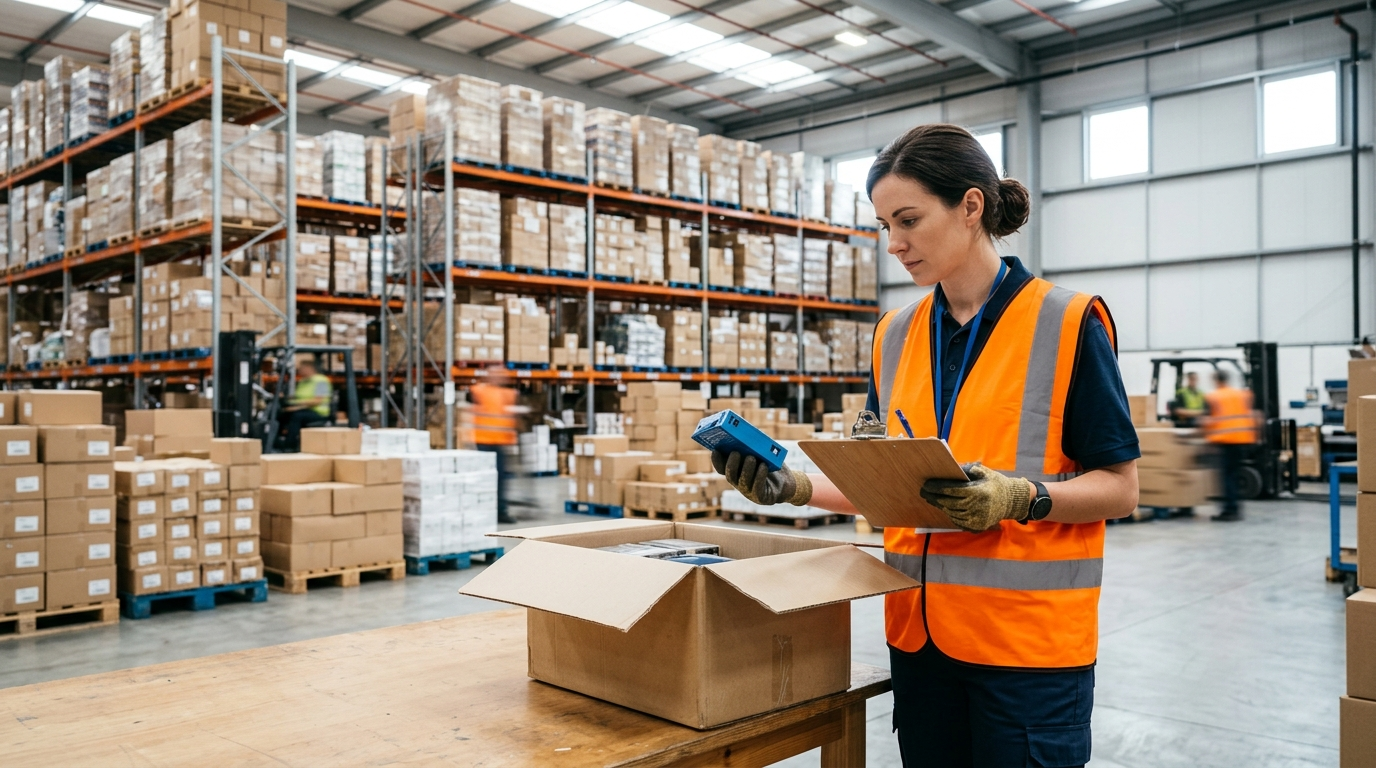
Short answer: Yes — you can have someone physically check the goods before they ship, and before you pay the balance. A pre-shipment inspection in China sends an independent inspector into the factory once your order is roughly 80–100% produced and packed. Using random AQL sampling, the inspector verifies quantity, workmanship, function, measurements against your approved sample, labels, and packaging, then sends you a pass or fail report the same day. Because it happens before the balance payment, you keep the leverage to make the factory fix problems while they still need your money.
Here is what that inspector actually checks, how the sampling works, and why the moment you schedule it decides everything.
What a pre-shipment inspection (PSI) is — and when it happens
A pre-shipment inspection, often shortened to PSI, is a physical check of your finished order carried out by an independent inspector at the factory, before the goods leave for the port. The key word is independent. This is not the factory's own quality team signing off on their own work. It is a neutral third party working for you, the buyer.
Timing is what makes it a "pre-shipment" inspection rather than any other kind. It is scheduled when the order is roughly 80–100% produced and fully packed, but before you pay the balance and before the container is booked. At that point there is enough finished, boxed product to judge the whole batch fairly — yet the goods are still sitting in the factory, where the supplier can still fix or replace them.
Most inspections take one working day per inspector for a typical order. The inspector arrives, pulls a random sample from the packed cartons, works through a defined checklist, and sends you a report — usually with photos — the same day or the next morning. You then decide whether to release the balance, ask for rework, or hold the shipment.
How AQL sampling works, in plain language
No inspector opens every single unit in a 5,000-piece order. That would take days and cost more than the goods are worth. Instead, a professional AQL inspection in China uses statistical sampling: the inspector checks a random, representative sample of the batch and uses the result to judge the whole order.
"AQL" stands for Acceptable Quality Limit. In plain language, it is the agreed answer to one question: how many defective pieces are we willing to tolerate in the sample before we reject the whole batch? No mass-produced order is ever 100% perfect, so instead of pretending otherwise, buyer and inspector agree on a limit in advance. If the number of defects in the sample stays under that limit, the batch passes. If it goes over, the batch fails.
Two things make this fair. First, the sample is pulled at random from across the packed cartons, not hand-picked by the factory, so it reflects what a customer would actually receive. Second, not all defects are treated equally. They are sorted into three classes:
| Defect class | What it means in plain language | How strictly it is judged |
|---|---|---|
| Critical | A defect that could make the product unsafe or illegal to sell | Tightest tolerance — usually none accepted |
| Major | A fault a normal customer would notice and likely return the product for | A limited number tolerated |
| Minor | A small cosmetic flaw that does not affect use or sale | The most tolerant limit |
The exact accept and reject numbers depend on the standard you agree, your order size, and how strict you choose to be. They are set before the inspection, not invented on the day. The important idea is simple: the tolerance for a safety defect is far tighter than the tolerance for a tiny cosmetic mark, and you agree where those lines sit before anyone opens a carton.
The before-shipment inspection checklist: what the inspector actually checks
So how does a factory inspection work once the inspector is standing on the floor? They work through a structured before-shipment inspection checklist. The details vary by product, but the backbone is almost always the same:
- Quantity. Are all the cartons actually there, and does the real piece count match your purchase order? Short counts are more common than buyers expect.
- Workmanship. The inspector examines the random sample for the critical, major, and minor defects agreed above — scratches, loose stitching, uneven finish, poor assembly, and so on.
- Function tests. Anything that switches on, folds, zips, pours, or connects is tested. For electronics that can mean power-on and basic operation; for furniture, stability and moving parts.
- Measurements and specifications. Dimensions, weight, and materials are measured against your written specification and, crucially, against your approved golden sample — the reference unit everyone agreed the production run must match. This is where quality fade and quiet material swaps get caught.
- Barcodes and labels. Barcodes are scanned, and labels, care instructions, country-of-origin marks, and language requirements are checked against what your market demands.
- Packaging and a drop test. Retail and export packaging are checked, and a carton is often drop-tested to see whether the product survives normal handling in transit.
- Loading (optional). Some buyers add a loading check, where the inspector confirms the right goods, in the right quantity, are actually loaded into the container.
That measurement-against-the-golden-sample step is the one that protects you most over repeat orders. It is exactly where a supplier can substitute a cheaper material or a thinner component to protect their own margin — the slow problem we cover in our guide to material substitution and quality fade. An inspection turns "we think it matches the sample" into documented proof.
Why timing it before the balance payment is the whole point
Here is the part that first-time importers underestimate. On a normal China order you pay a deposit up front — often around 30% — and the balance before the goods ship. (If you are unsure whether that structure is safe, see our guide on paying a deposit to a Chinese supplier.) That unpaid balance is your leverage. It is the one moment when the factory still wants something from you.
> Once the balance is paid and the container has sailed, your leverage is gone. An inspection scheduled after payment tells you about a problem you can no longer easily fix. Scheduled before payment, the same inspection is a lever you can pull.
If the inspection passes, you release the balance with confidence. If it fails, you have a documented, third-party reason to withhold payment until the factory reworks, replaces, or re-inspects the goods. A supplier is far more cooperative when the final payment is still on the table than after the money has landed.
And the cost of that leverage is small. A China QC inspection cost is usually a modest flat day-rate per inspector — a fixed fee, not a percentage of your order. For most shipments it is a tiny fraction of the order value, and very small compared with the cost of receiving a container of unsellable goods. This is why experienced buyers treat third-party quality control in China as a standard line item, not an optional extra: the downside it prevents is enormous, and the price is fixed and predictable.
How Trade Entrust handles it
We run inspection as a discrete, standalone service, so you never release your balance on goods you have not verified. On your order, that means:
- We agree the standard with you first. Before production finishes, we confirm your golden sample, your specifications, the defect classes that matter for your product, and how strict the sampling should be — so the pass or fail line is set in advance, not argued about later.
- We put an independent inspector on the factory floor. A neutral third party — never the factory's own staff — pulls a random sample, works through the full checklist, and runs the function, measurement, and packaging tests.
- We report before you pay. You get a clear pass or fail report with photos while the goods are still in the factory and your balance is still unpaid, so you decide with full information.
- We manage the fix if it fails. If the batch does not pass, we press the supplier to rework, replace, or re-inspect before any balance is released.
You do not need to be sourcing your whole order through us to use this. Inspection is a service you can book on its own, on an order you arranged yourself.
Bottom line
A pre-shipment inspection in China is the difference between hoping your order is right and knowing it is. Before you release the balance, confirm that:
- The goods are 80–100% made and packed, so the sample is representative.
- An independent inspector — not the factory — pulls a random sample.
- Quantity, workmanship, function, specifications versus the golden sample, labels, and packaging are all checked.
- You hold the written report before the balance leaves your account.
Verify first. Pay second. That order is the whole point.
Want an independent inspector on your goods before you pay the balance? Get a quote from Trade Entrust for a standalone pre-shipment inspection, or read next how to make sure your bulk order matches the sample.