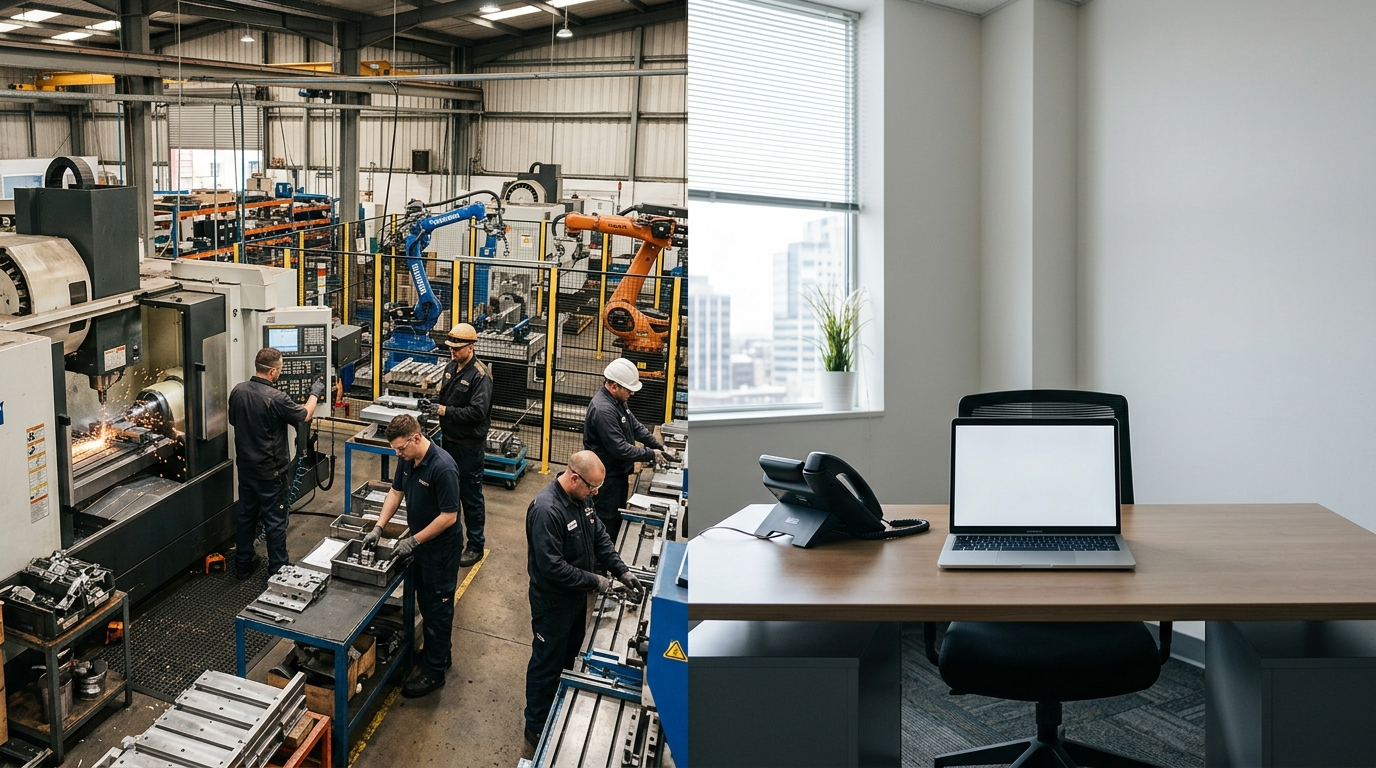
Short answer: To settle the real factory vs trading company China question, test three things. First, technical depth — a genuine manufacturer answers detailed questions about materials, tolerances, and process without "checking with the workshop." Second, a live video walk of the production line — a real factory shows it on request, while a middleman keeps finding reasons not to. Third, the paperwork — the business license scope, the factory address, and the company name on your invoice should all point to the same manufacturing entity. If a supplier sells dozens of unrelated products, dodges the line tour, and invoices under a different name, you are probably paying a trader's margin.
This is not about catching anyone out. It is about knowing exactly who you are paying, and what you are paying for.
Why it matters: price, quality, and accountability
The real factory vs trading company China distinction affects three things that decide whether your order succeeds.
Price. A trading company buys from the factory and resells to you. That margin is invisible — it is already included in the quote. It is often an extra 5% to 15%, and more on complex or low-volume orders. On the trading company vs factory price question, the gap rarely appears on any invoice; you simply pay it.
Quality control. A trader sits one step away from production. When you request a material change or report a defect, your message has to pass through the middleman to the factory and back. Details get lost. The people actually making your goods never hear from you directly.
Accountability. When something goes wrong in bulk, a real factory can stop the line, inspect, and rework. A trader can only forward emails. If the factory refuses to cooperate, the trader has limited power — and you have no direct relationship to rely on.
Here is how the two typically compare:
| Factor | Real factory | Trading company |
|---|---|---|
| Price | Factory-direct, no resale margin | Includes a hidden markup |
| Technical questions | Answered in detail, first-hand | Often vague or "will confirm" |
| Product range | Focused on one category | Many unrelated categories |
| Minimum order (MOQ) | Higher, set by the line | Sometimes lower (pools orders) |
| VAT invoice (fapiao) | Can usually issue directly | May route through a third party |
| Fixing problems | Controls the production line | Relays messages only |
Neither column is "bad." The danger is not knowing which one you have.
The tells that your "factory" is actually a trader
Most middlemen do not lie outright — they let you assume. Watch for these signals when you ask, "is my Alibaba supplier a real manufacturer?"
- They sell too many unrelated things. A real injection-moulding plant does not also manufacture textiles, LED lights, and stainless steel bottles. If the catalogue spans many categories, you are likely looking at a trader who buys across factories.
- They go vague on technical questions. Ask about wall thickness, steel grade, stitch count, or a specific tolerance. A factory engineer answers directly. A trader says "no problem, we can do anything" or needs a day to reply — because they are asking the real factory.
- They will not video-call the production line. This is the clearest test. A manufacturer can point a phone at running machines in minutes. A middleman offers photos, an old video, or a "the factory is busy today" excuse.
- The address is an office, not a plant. Check the address on a map. A tower suite in a city centre is an office. Factories sit in industrial parks or on the edge of town.
- The company name does not match. If your quote comes from "ABC Trading Co." but the proforma invoice, bank account, or export documents show a different manufacturer's name, there is a layer between you and production.
> Being a trading company is not a crime, and many are excellent partners. The real problem is not knowing — and paying a factory-direct price for a middleman service you were never told about.
Documents and checks that prove who you are dealing with
Signals raise suspicion; documents settle it. Here is how to verify a China factory before you commit.
1. Read the business license scope. Every legitimate Chinese company has a business license with a registered "business scope." A manufacturer's scope includes production or processing of its goods. A pure trader's scope lists wholesale, retail, or import/export only. A business license check on a China supplier takes minutes and is the single most useful document you can request. Match the company name and registration number against the invoice you will pay.
2. Confirm VAT-invoice ability. A registered manufacturer that is a general taxpayer can usually issue an official VAT invoice (fapiao) at the standard 13% rate for most goods. A small trader may only issue a general invoice or route the fapiao through the factory — which quietly confirms they are not the maker.
3. Get a factory audit. A factory audit in China — done by you, a sourcing partner, or a third-party inspector — verifies that the plant exists, runs the right machines, and has the capacity and certificates it claims. An audit is the difference between a website and a verified supplier. It is also the best moment to catch a trader posing as a factory.
4. Ask for a live video walk of the line. Book a scheduled video call and ask them to walk from raw material, through the machines making your product, to packing. A real factory treats this as normal. If you can visit in person, even better — our factory visit preparation guide covers exactly what to inspect and which questions expose a middleman.
Going factory-direct: how it changes price and control
Going direct to the maker changes two things. On price, you remove the resale margin — the same order can cost noticeably less once no one is reselling it to you. On control, you talk to the people who actually make your product, so changes, quality standards, and problems are handled at the source rather than relayed through a third party.
But here is the honest part. A good trading company or sourcing agent can genuinely add value. They can pool small orders to give you a lower MOQ, coordinate several factories into one shipment, handle language and quality follow-up, and reduce your workload. That service is worth paying for — when you know you are paying for it.
The problem is only the hidden version: a middleman telling a factory-direct story while quietly adding a margin you cannot see. So the goal is not to avoid every intermediary. It is to know which one you have, and to pay a fair, transparent fee for real work instead of an invisible markup. If you are weighing that choice, our guide on whether a sourcing agent fee is worth it explains when it pays off.
How Trade Entrust handles it
We remove the guesswork on real factory vs trading company China sourcing, so you always know who is making your goods.
- We verify the entity. We check the business license, business scope, registration number, and VAT status, and match them against the company that will invoice and ship to you.
- We audit the plant. We arrange or conduct a factory audit — in person or by scheduled live video of the production line — to confirm the maker is real and has the right capacity and equipment.
- We go factory-direct. Where it serves you, we source straight from the manufacturer so there is no hidden resale margin, and you pay a transparent fee for our work instead of an invisible middleman markup.
- We stay honest about intermediaries. When a trading partner genuinely helps — lower MOQ, multi-factory coordination — we tell you, and we make sure the cost is visible and justified.
Bottom line
Use this quick checklist before you place a bulk order:
- Business license scope says "manufacturing," not only "trade"
- Company name matches on the quote, invoice, and bank details
- Technical questions answered in detail, first-hand
- Live video walk of the running production line completed
- Factory address is a plant, not a city-centre office
- VAT-invoice ability confirmed
- Any intermediary and their fee are disclosed and agreed
If most boxes are ticked, you are buying from a verified maker at a fair price. If they are not, you may be paying a middleman without knowing it.
Not sure if your supplier is the real factory? Get a quote and we will verify the manufacturer, audit the line, and source you factory-direct — see also our guide to working with a China sourcing agent.