Short answer: Paying for a mould does not automatically make it yours. In China manufacturing, who owns the mould is decided by what your written contract says — not by who paid the tooling invoice. Unless a signed mould-ownership clause names you as the owner and gives you the right to move the tooling, the factory can treat the mould as its own property and refuse to release it. Put ownership, physical access, and the right to move tooling to another factory in writing before you pay the first tooling deposit.
That single clause is the difference between a custom product you control and a custom product that locks you to one supplier for its whole life.
What tooling and moulds actually are — and why they cost what they cost
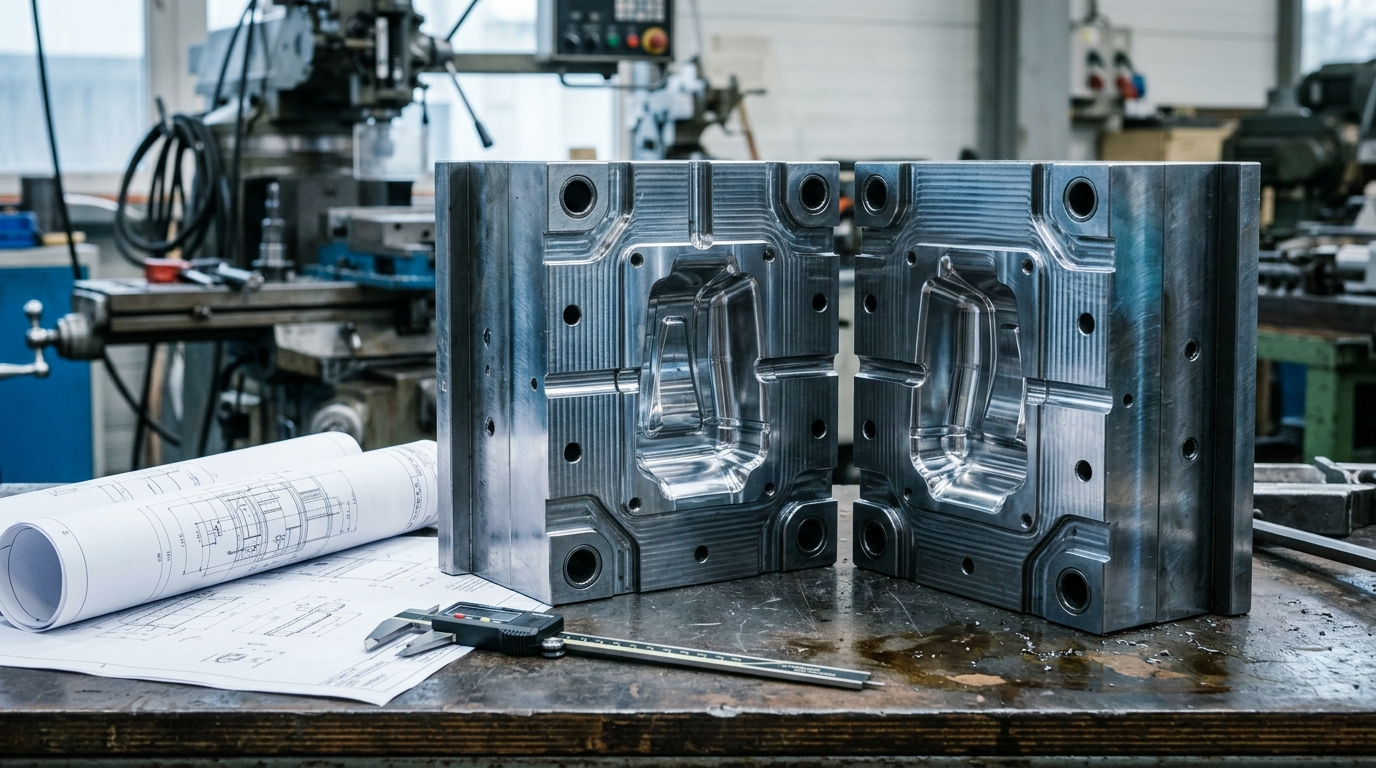
A mould (or "tool") is the custom metal block that shapes your product. For plastic parts it is an injection mould; for metal parts it may be a die or a casting tool. It is made once, then used to produce thousands or even millions of identical parts. This is why tooling is a separate, one-time setup cost, quoted apart from the per-unit price of the goods.
Tooling cost in China is usually lower than in Europe or North America, but it is still a real investment — often from a few hundred dollars for a simple aluminium tool to tens of thousands for a large, multi-cavity hardened-steel mould. Four things drive the tooling cost:
- Material of the tool itself — aluminium is cheap and fast but wears out; hardened steel is expensive but lasts for a very high number of cycles.
- Complexity — undercuts, tight tolerances, sliders, and fine surface finish all add machining hours.
- Number of cavities — a single-cavity mould makes one part per cycle; a multi-cavity mould makes several at once, costing more up front but lowering the per-unit price at volume.
- Part size — bigger parts need bigger tools and bigger machines to run them.
| Factor | Aluminium tooling | Hardened steel tooling |
|---|---|---|
| Up-front cost | Lower | Higher |
| Typical life (cycles) | Thousands to ~100k | Hundreds of thousands to millions |
| Lead time to cut | Faster | Slower |
| Best for | Prototypes, low volume, market tests | Mass production, long product life |
| Repairability | Limited | Good — can be re-cut and maintained |
One cost point to clarify early: is a mould deposit refundable? Sometimes a factory offers "free" or discounted tooling and quietly amortises the cost into the unit price, or takes a tooling deposit it promises to refund after you order a certain quantity. These deals can be fair, but they usually come with a catch — the factory keeps the mould, so "free tooling" often means you never own it. Always ask, in writing, whether the mould deposit is refundable, what triggers the refund, and who owns the tool afterwards.
Who owns the mould by default — and how to make it explicitly yours
Here is the point that surprises most first-time buyers: "I paid for it" does not automatically mean you own it. Injection mould ownership in China follows the contract, not the payment. If your paperwork is silent on the subject, the factory that cut and holds the mould can, in practice, treat it as theirs — because they built it, they possess it, and they run it on their own machines. Recovering a tool you cannot prove is yours is slow and expensive.
> The tooling invoice is a receipt, not a title deed. In China manufacturing, who owns the mould is set by the contract — not by who paid.
To make the tooling explicitly yours, you need a written mould-ownership clause, and sometimes a separate tooling agreement. At a minimum it should state:
- That you are the legal owner of the mould and of any spares, hot runners, and inserts.
- That the mould will be marked and numbered as your property.
- Your right to inspect, photograph, and remove the tooling on reasonable notice.
- What happens to the mould if you stop ordering, or if there is a dispute over payment.
- That the factory may not use your tooling to make the same product for anyone else.
The contrast between having this clause and going without it is stark:
| Mould-ownership clause in place | No clause (silence) | |
|---|---|---|
| Who is the legal owner | You, in writing | Disputed — often the factory in practice |
| Right to move tooling | Yes, agreed up front | Uncertain; factory may refuse |
| Factory makes your part for others | Prohibited | Hard to stop |
| Leverage in a price dispute | You keep it | Factory keeps it |
| Cost to fix later | Low | High, or impossible |
Moving tooling between factories — the reality of a mould "held hostage"
This is where buyers get hurt. When a relationship goes bad — a sudden price increase, a quality problem, or slow delivery — you may want to move tooling to another factory. If you never agreed the right to do that, the current factory can hold the mould "hostage": it simply refuses to hand the tool over until you keep ordering or pay extra. Even a mould you clearly own is only useful if you can physically get it back.
A few realities to plan for before you sign:
- Moulds wear out. Every tool has a finite life, measured in shots or cycles. A tool near the end of its life may not be worth moving — factor the remaining life into any transfer decision.
- T1 samples matter. When a mould moves to a new factory, that factory should run the tool and send you T1 samples — the first trial shots from the tool — so you can confirm the parts still meet spec before mass production restarts. Moving a tool almost always needs re-tuning on different machines.
- Documentation travels with the tool. The new factory needs the mould itself, the drawings, the material spec, and the process notes. If the old factory holds any of these, the move stalls.
Agree the exit up front: your right to remove the tool on notice, a clear list of what leaves with it, and a limit on any final balance the factory can claim before release. The same discipline that prevents surprises later — writing the important things down before production begins — is exactly what keeps your tooling mobile.
Protecting your design, drawings and IP
Owning the steel is only half the job. In custom product manufacturing in China you also need to protect the design that the steel produces. Two tools do most of the work.
First, an NNN agreement (Non-disclosure, Non-use, Non-circumvention), drafted for China and ideally written in Chinese under Chinese jurisdiction. Unlike a standard Western NDA, an NNN also stops the factory from using your design for its own products, or selling around you directly to your customers.
Second, keep control of the master files. You, or your agent, should hold the master CAD and 2D drawings — not just the factory. Provide what the factory needs to produce, but keep the authoritative source yourself, so no single supplier is the only party able to remake your tool. Where the product justifies it, register your design or trademark in China as well.
Finally, make ownership visible: have the mould physically marked and numbered with your name or an asset tag, and photograph it. When you or an inspector are on site, confirm the tool exists, matches the number in your contract, and is stored safely — one of many reasons a planned factory visit pays for itself on a high-value custom project.
How Trade Entrust handles it
We treat tooling as an asset you own, not a favour the factory does you. On a custom project we:
- Put ownership in writing. We negotiate a mould-ownership clause that names you as legal owner, covers spares and inserts, and confirms the tool will be marked and numbered as your property.
- Secure the right to move tooling. We agree exit terms up front — your right to remove the mould on notice, what documentation travels with it, and limits on any final balance — so a dispute never turns into a hostage situation.
- Protect your drawings and IP. We arrange a China-enforceable NNN agreement, help you keep the master CAD and drawings, and make sure the tool is physically tagged as yours.
- Check the tooling is real and sound. During inspection or a factory visit we confirm the mould exists, review the steel-versus-aluminium and cavity choice against your real volumes, and sign off T1 samples before mass production.
Having a China sourcing partner hold this line during negotiation — before any deposit is paid — is far cheaper than trying to recover a mould after the relationship has already soured.
Bottom line
Before you pay a tooling deposit on a custom product, get these five things in writing:
- A mould-ownership clause naming you as the owner.
- The right to move tooling to another factory on notice.
- Whether any mould deposit is refundable, and what triggers the refund.
- An NNN agreement, plus you holding the master CAD and drawings.
- The mould marked, numbered, and photographed as your property.
Get those right and your custom project stays yours — portable, protected, and never locked to a single factory.
Developing a custom product and want ownership of the tooling secured before you commit? Get a quote from Trade Entrust, and read next how we stop material substitution and quality fade once production begins.